

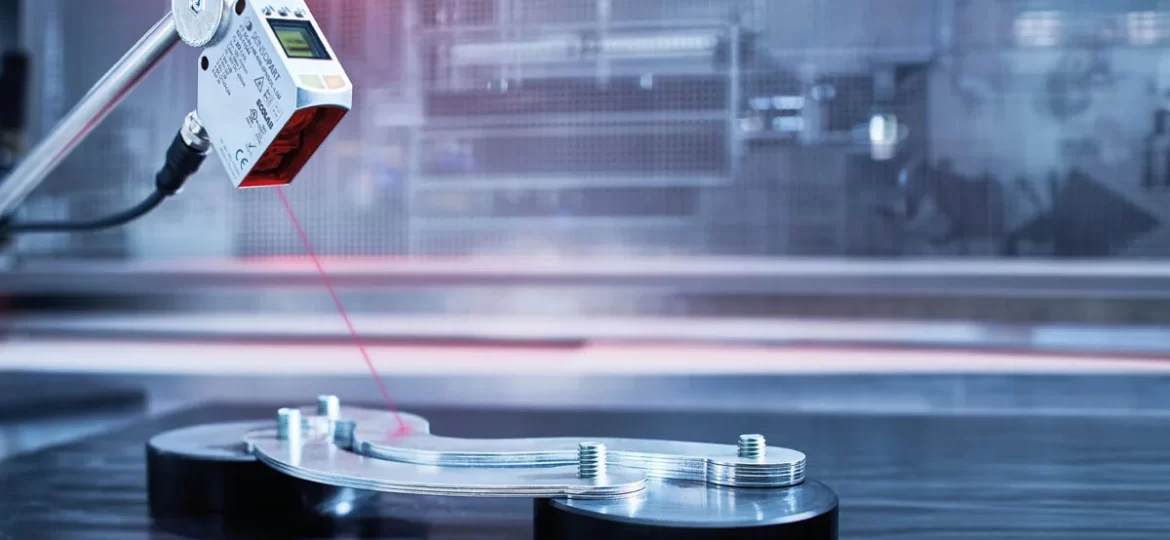
Photoelectric sensors are devices that detect work particles using optical properties. These sensors basically consist of two components, a light emitting unit (emitter) and a light receiving unit (receiver). When the light emitted by the emitter is interrupted or reflected by the detected object, a change occurs in the amount of light reaching the receiver. The receiver detects this change and converts it into an electrical output. Usually the light source for these sensors is infrared or visible light.
Types of Photoelectric Sensors
Photoelectric sensors are available in various types and differ according to their application. The most common types are:
1. Diffuse-Reflective Sensors:
These sensors are based on the principle that the light emitted by the emitter hits the object and is reflected back to the receiver.
2. Through-Beam Sensors:
The emitter and receiver are placed opposite each other. The object interrupts the light beam between the two units and detection takes place.
3. Retroreflective (Retro-Reflective) Sensors:
The emitter and receiver are in the same unit. The light is reflected back from the object and detected by the receiver.
4. Distance Adjustable Sensors:
These sensors allow objects to be detected at a certain distance by adjusting the detection distance.
Working Principles of Photoelectric Sensors
The operating principles of photoelectric sensors are related to the properties of light and light sources. Here is some basic information about these principles:
1. Light Properties:
Light travels in a straight line and does not refract at a low speed when passing through different media. Flat surfaces (e.g. glass or mirrors) reflect light at an incident angle. This type of reflection is called “uniform reflection”. A corner cube exploits this principle by using the uniform reflections of three flat surfaces perpendicular to each other.
2. Light Sources:
Photoelectric sensors usually use pulsed modulated light. This method reduces the effects of external light interference. In models with mutual interference protection, the emission cycle is changed at regular intervals.
3. Light Source Color and Type:
Photoelectric sensors usually use light sources such as LEDs. The light emitted from LEDs oscillates in the vertical and horizontal direction, which is referred to as “unpolarized light”. Polarizing filters achieve polarized light by limiting the oscillations of light in only one direction. For example, the MSR function in retro-reflective sensors and the Mutual Interference Protection Filter in through-beam sensors are based on this principle.